
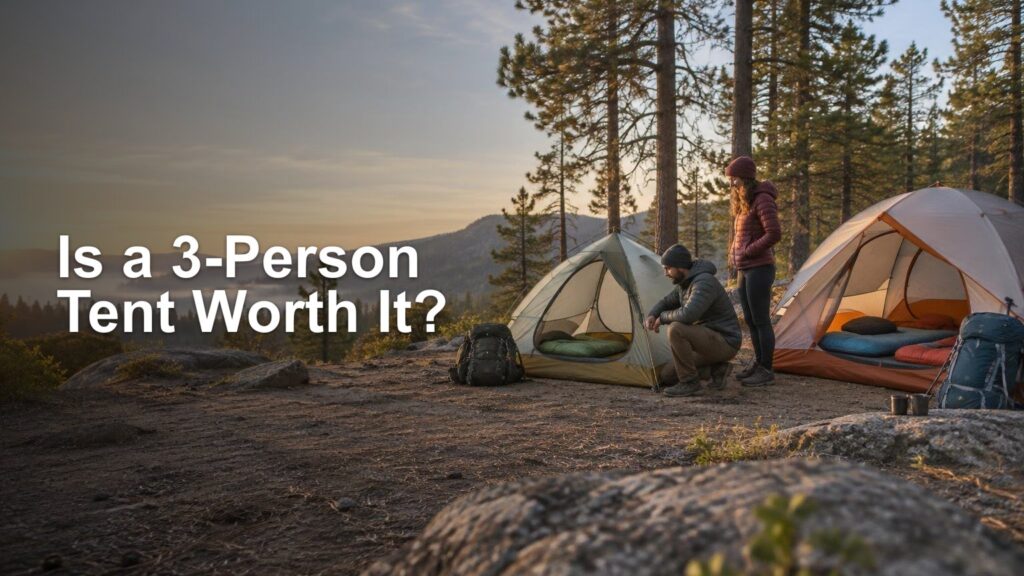
TLDR: Choose around your trip, pads and tolerance for elbows
For most two-person car-camping trips, a 3-person tent is worth the extra space. It gives two campers more room to change clothes, organize gear and wait out bad weather, while the added weight matters little when a vehicle handles the hauling.
For backpacking, a well-designed 2-person tent is usually the more efficient choice when both campers fit comfortably and want to control pack weight. Move up to a 3-person model if you use wide sleeping pads, regularly bring a dog, expect long evenings inside or simply value room more than a smaller packed shelter.
Do not decide from the capacity label alone. Tent person ratings are not standardized comfort measurements, so two models marked “2P” can have noticeably different widths, lengths, wall angles and usable headroom. Compare actual dimensions and floor shape before buying. The REI guide to choosing a backpacking tent provides a useful overview of these variables.
The practical difference between a 2-person and 3-person tent
| Factor | 2-person tent for two | 3-person tent for two |
|---|---|---|
| Sleeping space | Usually efficient but potentially snug | More shoulder, elbow and pad space |
| Interior gear storage | Limited once two pads are down | More room for clothing and essential gear |
| Vestibules | Can be sufficient if there are two large vestibules | May be larger, but not always |
| Weight and packed size | Usually lower and easier to carry | Usually higher and bulkier |
| Car camping | Works, especially on small tent pads | Often the more comfortable choice |
| Backpacking | Usually the efficient default | Useful when livability justifies the load |
| Bad-weather downtime | Less room for sitting and sorting gear | More comfortable for extended time inside |
These are tendencies rather than rules. A roomy, steep-walled 2P tent can feel better than a low, aggressively tapered 3P. A larger capacity number also says nothing by itself about ventilation, storm strength or vestibule layout.
Floor area helps, but floor shape decides whether it is usable
REI offers a rough front-country benchmark of about 29 to 33 square feet for two people, rising to approximately 40 to 45 square feet for two sleepers who toss and turn. Those figures are useful starting points, not universal sizing rules. Actual comfort depends on where the width is located and whether the walls lean sharply inward.
Check the width at both the head and foot ends. Many backpacking tents taper to reduce fabric and weight. That can work beautifully with tapered sleeping pads, but it may create an awkward puzzle when two campers bring rectangular or wide pads. Also compare floor length if either camper is tall; a long floor loses some of its advantage when a low end wall presses against the sleeping bag.
NEMO’s Dagger OSMO illustrates how much the width can change within one tent family. The 2P has an 88-by-50-inch rectangular floor, while the 3P measures 88 by 70 inches. NEMO says the 2P can accommodate combinations including two regular pads or two wide pads, but the 3P leaves considerably more free width around two wide pads.
A simple buying check is to add the widths of both sleeping pads and compare the result with the tent’s width at the relevant points. If the pads consume nearly the entire floor, expect little room for clothing, electronics or the midnight maneuver required to find a headlamp that was definitely right there.
Shoulder room and headroom can matter more than the capacity label
Floor dimensions tell you where the pads fit. Wall geometry tells you whether two people can sit up, change layers and move around without colliding. Near-vertical sidewalls and a broad ceiling create more usable volume than a single high point surrounded by steep slopes.
Look beyond peak height and ask where that height exists. A tent with one tall point in the center may force both campers into the same sitting position. Two-door tents with supportive pole structures often provide better independent living space, although the exact design matters more than the number of poles or doors alone.
If possible, sit inside the pitched tent with your usual camping partner. Place your pads on the floor, sit at the same time and imitate changing a shirt or reaching for gear. Five slightly silly minutes in a showroom can reveal more than an impressive capacity badge.
Vestibules can make a good 2-person tent feel much more workable
A vestibule is the covered area beneath the rainfly but outside the inner tent. It provides sheltered storage for boots, packs and other equipment that does not need to share the sleeping compartment. Two doors and two vestibules are especially useful for couples because each camper gets an entrance and a storage zone.
Still, vestibule area is not interchangeable with interior space. It does not give you a clean place to change clothes, sit with a dog or organize sensitive gear during rain. It also may not increase when you move up one capacity size. Big Agnes lists two 0.8-square-meter vestibules on both the Copper Spur UL2 and UL3, for example, meaning the larger model’s stated space gain is primarily inside the sleeping compartment.
Compare the number, shape and opening direction of the vestibules rather than assuming every 3P has better storage. A deep vestibule can swallow a pack but obstruct the door; a long, shallow one may make equipment easier to reach.
The weight penalty matters most when you carry it
For backpacking, compare equivalent weight figures. Trail or minimum weight generally covers the essential tent body, rainfly and poles, while packaged weight includes the supplied sacks and accessories. Mixing those figures can make one shelter appear lighter than it really is.
The Copper Spur family offers a useful like-for-like example. Big Agnes lists the UL2 at about 29 square feet and 2.6 pounds of trail weight, with a packed size of 50 by 11 centimeters. The UL3 is listed at about 41 square feet, 3.4 pounds of trail weight and 53 by 13 centimeters packed. In this case, moving to the 3P adds roughly 12 square feet and 12 ounces of trail weight.
Twelve ounces shared between two hikers may be a reasonable price for that extra room, particularly on relaxed trips with short daily mileage. It becomes a less attractive trade on long routes where every piece of equipment competes for pack space. The right answer depends on your complete load, not an arbitrary rule that lighter is always better. Our guide to backpacking tents versus camping tents explains how those priorities change between trail and front-country use.
Partners can also divide a shared shelter between their packs, with one carrying the poles and body while the other carries the fly and stakes. That reduces each person’s individual share, although it does not change the tent’s total weight. Some tents include stuff sacks designed to make this split easier.
A 3-person tent improves weather-day comfort, not weather resistance
Extra interior room becomes particularly valuable when rain, wind or insects keep both campers inside for hours. You can sit without occupying the same patch of floor, keep important gear away from wet doors and rearrange layers without treating your partner like part of the tent structure.
That comfort advantage does not mean a 3P tent is inherently stronger or safer in bad weather. Storm performance depends more directly on the tent’s season rating, pole structure, fabrics, rainfly coverage, guylines, ventilation, campsite exposure and quality of the pitch. Capacity alone does not establish weather suitability.
Ventilation deserves the same model-specific attention. Two people release moisture through breathing overnight, so mesh panels, fly vents and a well-pitched rainfly help manage condensation. More interior volume may make a shelter feel less crowded, but simply buying a 3P does not guarantee a drier inner wall.
For another real-world data point, a Backpacker evaluation of the Copper Spur UL3 describes a 41-square-foot tent with 18 square feet of vestibule space. Its tester found the interior usable for three adults with cold-weather sleeping bags and gear. That is encouraging evidence for that model, but it should not be treated as a promise that every 3P tent offers the same usable room.
Car camping favors comfort; backpacking favors efficiency
For car camping
A 3-person tent is the better default for two car campers unless vehicle storage, campsite size or setup simplicity points toward a smaller shelter. The added room is useful every night, while the additional carrying burden often lasts only for the walk from the trunk to the tent pad. Vehicle transport makes trail weight less important, but you should still verify the packed dimensions and the size of the site where you plan to camp.
The larger option is especially appealing for bulky bedding, a pet, extended stays or trips with uncertain weather. Keep the rest of the load under control with a consistent camping gear organization system, because tents have a mysterious talent for becoming the smallest item in an overfilled vehicle.
For backpacking
Start with a 2-person tent and move up only when you can name the benefit you are buying. Good reasons include two wide pads, a large difference in camper size, a dog sleeping inside, frequent wet-weather trips or a strong preference for personal space. A vague belief that bigger must be better is less persuasive when the shelter occupies more of both packs on every mile.
If your priority is minimum weight, compare the larger tent not only with the 2P version but also with other shelter styles. Beginners curious about going lighter can review the practical differences between a backpacking tent and a tarp shelter, including insect protection and setup demands.
A quick decision checklist
- Measure both sleeping pads and compare their combined width with the tent at the head and foot ends.
- Check floor length, wall angle and the amount of ceiling area near peak height.
- Confirm whether the tent has one or two doors and how much usable space each vestibule provides.
- Compare matching trail-weight or packaged-weight figures between models.
- Check packed dimensions against your backpack or vehicle storage space.
- Consider how often rain, bugs or early darkness will keep both campers inside.
- Account for indoor extras such as a dog, clothing, electronics or bulky sleep systems.
- For front-country sites, confirm that the larger footprint will fit the designated tent pad.
The verdict: buy the smallest tent that still feels comfortable
Choose a 2-person tent when you are backpacking, use compatible pads and are comfortable keeping most gear in the vestibules. It is typically lighter, smaller to pack and easier to place on compact sites.
Choose a 3-person tent for two campers when comfort carries more weight than the tent does. It is usually the stronger choice for car camping, wide pads, pets, longer stays and trips where both people may spend meaningful time inside.
The extra space is worth it when you will use it often enough to justify the added weight, packed volume and footprint. Compare actual measurements within the same tent family, place your sleeping pads on the floor if possible and let the trip—not the capacity label—make the final decision.
References
- Backpacking Tents: How to Choose | REI Expert Advice
- What to Look for in a Camping Tent | REI Expert Advice
- What size sleeping pads fit in your tent? – NEMO Equipment Support
- Backpacking Tents: How to Choose | REI Expert Advice
- Tienda ultraligera Copper Spur UL2 | Big Agnes | Big Agnes Europe
- The Best Backpacking Tents of 2026: Tested | REI Expert Advice
- Dagger OSMO Backpacking Tent – NEMO Equipment
- The 7 Best Backpacking Tents of 2026