
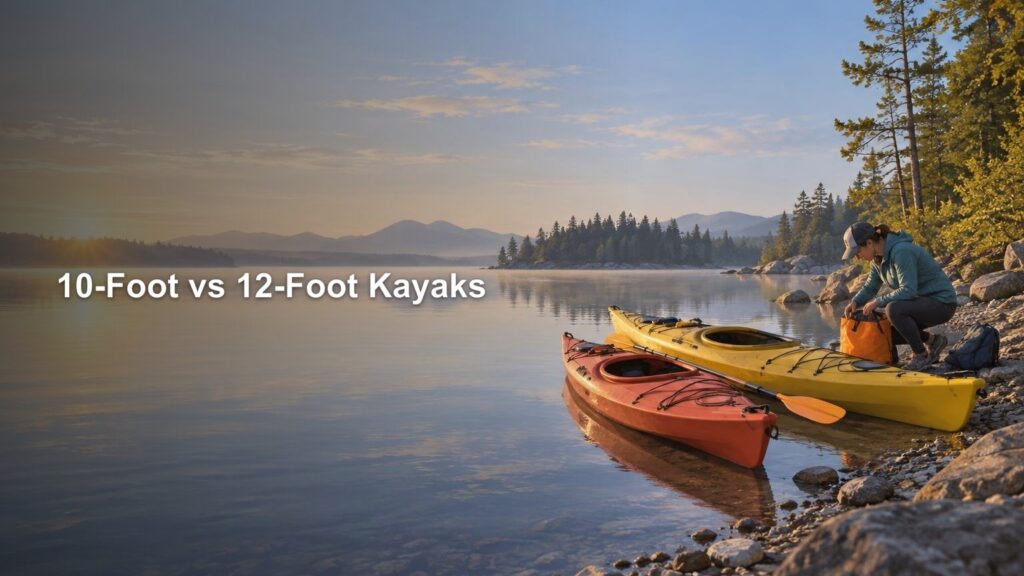
TLDR: In a 10 foot vs 12 foot kayak comparison, the 10-footer is often the easier choice for short outings, frequent turns, solo handling, and limited storage. A comparable 12-footer usually favors straighter tracking and maintaining pace on longer trips. But length is only a starting point: rocker, width, hull shape, fit, load capacity, and the type of water you paddle can overturn the expected result.
For most recreational paddlers, the decision should begin with water and logistics rather than paddler height. Choose 10 feet if you primarily explore sheltered ponds, small lakes, or narrow slow rivers and want a compact boat. Lean toward 12 feet for longer outings on larger lakes or broad, slow rivers—provided you can comfortably carry, transport, and store it.
This comparison applies to broadly similar recreational hard-shell kayaks. A wide sit-on-top fishing kayak and a narrow sit-inside recreational kayak will not behave alike simply because both are 12 feet long. If you are still comparing categories, start with this overview of different types of kayaks.
10 Foot vs 12 Foot Kayak at a Glance
| Decision factor | 10-foot kayak tendency | 12-foot kayak tendency |
|---|---|---|
| Tracking | May require more frequent corrective strokes | Often holds a straighter course when hulls are otherwise comparable |
| Turning | Often feels more responsive in tight spaces | May require more room to change direction |
| Maintaining pace | Well suited to short, casual paddles | Often better for covering distance efficiently |
| Handling on land | Shorter footprint can simplify carrying and loading | Extra length can make solo loading more awkward |
| Storage | Easier to fit in garages, sheds, or wall systems | Requires two additional feet of clear storage length |
| Gear | Can work for light day-trip loads if capacity and space are adequate | May offer more usable storage, depending on the model |
| Typical water | Sheltered water and winding, slow waterways | Larger lakes and broad, slow rivers |
| Paddler fit | Depends on seat, cockpit, foot braces, volume, and capacity | Depends on the same factors; length alone does not guarantee more room |
These are tendencies, not promises. The American Canoe Association explains that a longer craft generally has more speed potential when the boats, paddlers, and conditions are otherwise similar, with maneuverability as a common tradeoff. Its beginner’s guide to paddlesports also identifies width, rocker, and bottom shape as important handling variables.
What Two Extra Feet Can Change
Tracking describes a kayak’s tendency to continue in a straight line. Better tracking means you can spend less effort correcting the bow after each stroke. Maneuverability describes how readily the kayak turns, pivots, or changes course.
A longer waterline generally helps a comparable 12-foot boat travel straighter and maintain pace. That can be useful when crossing a lake or paddling several miles along a broad river. It does not create a guaranteed speed advantage: paddling technique, wind, current, total load, hull width, and hull profile all influence progress.
A 10-foot boat generally has a smaller turning footprint. That can feel more manageable when navigating a winding channel, approaching a busy launch, or turning around near shore. The tradeoff is that a short kayak designed for easy turning may wander more between strokes.
This is why the better question is not simply, “Which length is faster?” Ask whether your usual trip rewards straight-line efficiency or quick direction changes.
Hull Shape Can Matter as Much as Length
Length receives attention because it is easy to compare on a product page. Hull design is harder to summarize, but it can matter just as much.
Rocker changes the balance between turning and tracking
Rocker is the upward curve running from the middle of the hull toward the bow and stern. More rocker reduces how much of the ends engage the water, generally helping the boat turn. Less rocker keeps more of the keel line engaged and usually favors straight travel. A rockered 12-footer can therefore turn more readily than its length suggests, while a straight-keeled 10-footer may track better than expected.
Width affects stability and efficiency
A wider recreational kayak may feel reassuringly steady when you first sit in it. That initial stability can be useful for casual paddling, photography, or getting comfortable on the water. Added width can also create more resistance, so a broad 12-footer is not automatically quicker than every narrower 10-footer.
Bottom profile changes how the boat feels
Flat, rounded, V-shaped, and multi-chine bottoms interact with the water differently. Some prioritize a settled, stable feeling; others transition more smoothly from edge to edge or hold a course more deliberately. Compare the whole hull rather than treating length as a complete performance specification. For a broader shopping framework, see our guide to choosing the right kayak.
When a 10-Foot Kayak Is the Better Starting Point
A 10-foot recreational kayak is a sensible starting point when convenience determines how often you will actually paddle. It is especially worth considering for short outings on protected water, slow waterways with frequent bends, and homes where two extra feet create a real storage problem.
Choose the shorter option when most of these statements fit:
- Your trips are generally short and close to shore.
- You paddle sheltered ponds, small lakes, or narrow slow rivers.
- Quick turns matter more than holding a straight course over distance.
- You expect to load and unload the kayak without help.
- Your garage, shed, vehicle, or rack has limited room.
- You carry a modest day-trip load rather than extensive camping equipment.
Do not assume the shorter kayak will also be lighter. Materials, width, outfitting, molded seats, storage systems, and accessories all affect hull weight. Check the listed weight for the actual model, then confirm that you can control it while lifting—not merely pick up one end in a showroom.
When a 12-Foot Kayak Is the Better Starting Point
A 12-foot recreational kayak often makes sense when the outing involves sustained forward travel. It may require fewer course corrections than a comparable 10-footer, making it appealing for longer day paddles, larger lakes, and broad slow-moving rivers.
Lean toward 12 feet when these priorities apply:
- You regularly paddle longer routes rather than staying near one launch area.
- Your usual water rewards steady tracking more than quick pivots.
- You want room for day-trip equipment or occasional overnight gear.
- You can transport the boat securely and lift it to the required height.
- You have measured storage space rather than estimating it optimistically.
- The specific boat fits your body and remains within its stated capacity with your complete load.
Extra length does not automatically mean adequate camping capacity or well-designed storage. Inspect hatch openings, deck rigging, compartment shape, and access while seated. If multi-day trips are the goal, use a dedicated kayak-camping packing plan to estimate what the boat must hold before buying it.
Choose for Lakes and Rivers, Not a Generic Category
West Marine describes recreational kayaks as commonly falling within the 10-to-12-foot range and associates the category with calm lakes, slow rivers, and flat-water bays. It also notes that recreational designs often emphasize easy turning and initial stability rather than effortless straight-line travel.
Sheltered ponds and small lakes
A 10-footer is often enough for relaxed shoreline exploration where distances are short and conditions are mild. A 12-footer remains reasonable if you prefer steadier tracking, but its advantage may be less noticeable on a brief paddle.
Larger or breezier lakes
A suitable 12-footer may be the better recreational starting point when you expect longer crossings or sustained travel. Length alone does not make a boat appropriate for exposed water, strong wind, waves, cold water, or rapidly changing weather. Those conditions require suitable design, skills, clothing, flotation, and trip planning.
Narrow and winding slow rivers
A maneuverable 10-footer can be more convenient where the channel bends frequently or obstacles require regular course changes. Rocker may matter more than the number on the length specification, so examine the hull profile.
Broad slow rivers
A 12-footer can work well when the river is wide, bends are gradual, and the goal is to cover distance. A long kayak is not inherently unsuitable for a river; it simply needs enough room for its turning radius and a design appropriate to the conditions.
Neither recreational length should be treated as an automatic choice for technical whitewater, surf, or hazardous open-water travel. Those uses call for purpose-built boats and the relevant paddling skills.
Paddler Size, Comfort, and Capacity
A tall paddler does not automatically need a 12-foot kayak, and a shorter paddler does not automatically belong in a 10-footer. Fit depends on the usable cockpit or seating area, legroom, foot-brace adjustment, deck height, seat dimensions, hull volume, and load capacity.
Sit in the boat before buying when possible. Adjust the foot braces, maintain a natural bend in your knees, and check whether you can enter and exit without fighting the cockpit. For sit-on-top models, confirm that the seat and molded foot positions support you comfortably.
Capacity must account for the complete on-water load: paddler, clothing, water, food, paddle-related equipment, dry bags, and any fishing or camping gear. Do not compare capacity labels without also considering where the load sits. Poor weight distribution can affect trim, which is the kayak’s fore-and-aft balance in the water.
The ACA recommends matching a boat to the paddler’s purpose, body size, and skill level and trying boats where possible. A rental or demonstration session can reveal more about comfort and control than another hour comparing specification sheets.
Transport and Storage May Decide the Winner
The best kayak on the water is not very useful if getting it there becomes a wrestling match. Storage space and a suitable vehicle or rack system are practical considerations for any rigid kayak.
Before buying, measure the intended storage location, including doors, corners, ceiling height, wall brackets, and room needed to maneuver the hull into place. Do not assume a 12-foot wall means a 12-foot kayak will fit; you need clearance to move and support it.
Then inspect the actual boat’s weight and carry points. Think through the entire loading movement from ground to vehicle, including rack height. A longer hull may be awkward in crosswinds or confined parking areas even when its weight seems manageable. If possible, practice lifting the display boat or simulate the motion with an object of similar length and weight.
Five Checks Before You Choose
- Sit in or demo both lengths. Compare entry, foot-brace adjustment, seat support, turning response, and tracking.
- Read the actual specifications. Check hull weight, overall width, capacity, cockpit or seating dimensions, storage layout, and included equipment.
- Simulate transport. Confirm rack compatibility, tie-down points, loading height, carry distance, and whether one person can manage the boat.
- Compare rocker and hull profile. Do not let the length figure hide major differences in width and design.
- Budget for the complete setup. Include a suitable paddle, a properly fitted life jacket, transport equipment, and condition-appropriate safety gear.
Length is not a safety rating. The U.S. Coast Guard says recreational vessels must have a properly sized, serviceable, USCG-approved wearable personal flotation device for every person aboard. Federal guidance also generally requires children under 13 to wear one while underway, subject to stated exceptions and applicable state rules. Review the U.S. Coast Guard boating-safety guidance, wear your PFD, and check local requirements before launching. For additional preparation, use this kayaker safety essentials guide.
Common Questions About 10-Foot and 12-Foot Kayaks
Is a 10-foot kayak big enough for an adult?
It can be. Overall length does not determine fit by itself. Check seat or cockpit dimensions, foot-brace range, hull volume, and stated capacity against the paddler’s complete loaded weight.
Is a 12-foot kayak noticeably faster?
A comparable 12-footer generally has better speed potential and may maintain pace with fewer corrections. Whether the difference feels noticeable depends on hull shape, width, wind, current, load, technique, and trip distance.
Does a 12-foot kayak always track better?
No. A longer waterline usually favors tracking, but rocker and hull profile can change the result. A straighter 10-foot hull may track better than a highly rockered 12-foot design.
Is a 10-foot kayak easier to turn?
Often, when comparing similar designs. Its shorter footprint can make direction changes easier, but a low-rocker 10-footer may resist turning more than a rockered 12-footer.
Should I choose sit-inside or sit-on-top before choosing length?
Usually, yes. Decide which general design suits your water, comfort preferences, entry and exit needs, and intended use. Then compare 10-foot and 12-foot models within that category.
The Practical Verdict
Choose a 10-foot kayak if compact ownership, short outings, and responsive handling matter most. Choose a 12-foot kayak if you commonly paddle farther on open, protected water and value tracking more than tight maneuverability.
Then verify that the individual boat supports that choice. Compare hull shape, rocker, width, fit, realistic loaded capacity, hull weight, storage layout, and your ability to transport it. If both lengths fit your life, demo them on water similar to where you expect to paddle. The better kayak is the one that handles your usual conditions comfortably—and makes it out of the garage often enough to matter.