
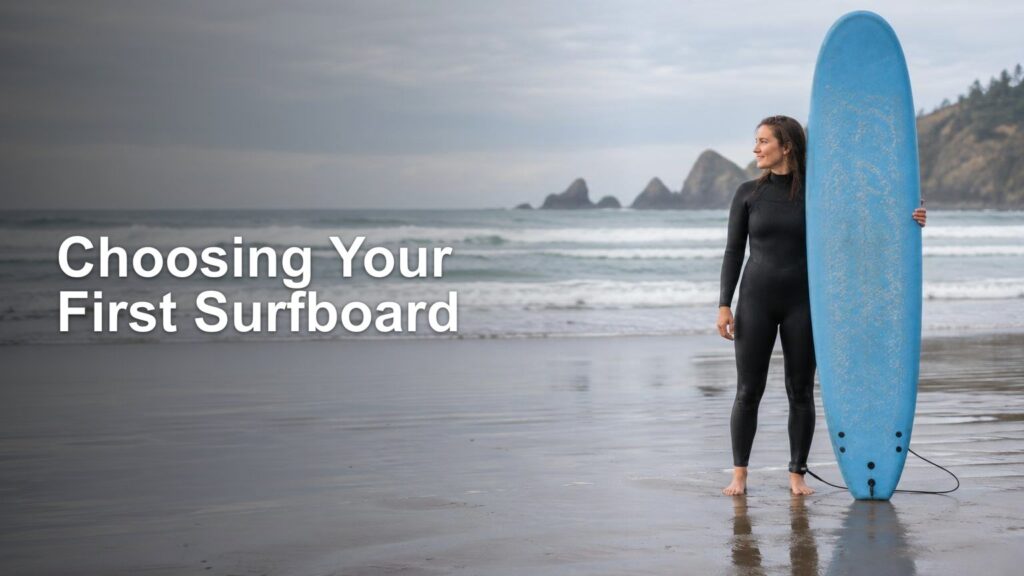
TLDR: Most beginners should use the largest soft-top or soft-core board they can comfortably carry, transport, and control in the water. For many adults, that points toward a stable longboard-style foam board rather than a shortboard. An 8-foot board can work, but a 9-foot board may be more forgiving for a heavier rider, an infrequent surfer, or someone learning in small, weak waves. Dimensions and volume matter, but there is no reliable universal formula that replaces an honest assessment of the surfer and local conditions.
If you are searching for what size surfboard for beginner use makes sense, prioritize easy wave-catching over maneuverability. A bigger, wider, fuller board generally gives you more flotation, paddling efficiency, and stability. That means more chances to catch waves and practice the skills that actually move a beginner forward.
The goal is not to buy the smallest board you might eventually ride. It is to choose a board that helps you paddle into waves, stand repeatedly, and learn basic direction control now. A forgiving board is a learning tool, not a disposable compromise.
Why larger surfboards usually help beginners
Early surfing progress depends heavily on repetition. You need enough successful wave entries to practice positioning, your pop-up, balance, and direction. A board that looks exciting but catches very few waves slows that process.
Larger beginner boards usually help in four connected ways:
- More buoyancy keeps the board riding higher and better supports the surfer’s weight.
- A longer waterline and fuller shape generally make paddling and gliding easier.
- More width and a generous outline provide a steadier platform for the pop-up.
- Better glide helps the board enter small or slow-moving waves earlier, giving the rider more time to stand.
This does not mean the biggest available board is automatically correct. A board becomes a poor choice if you cannot carry it to the beach, fit it in or on your vehicle, turn it around safely, or maintain control around other people. Choose generous dimensions within those practical limits.
What surfboard volume means
Surfboard volume is expressed in liters and is derived from the board’s length, width, thickness, and overall shape. It influences buoyancy, paddling, and wave-catching, but it does not describe the entire board. Rocker, rails, tail shape, and where the foam is distributed also affect how a board behaves. Surfing England’s surfboard selection guide provides a useful overview of how these design elements work together.
For beginners, more volume is generally forgiving because it helps the board support the rider and carry momentum. But two boards with the same listed liters can feel quite different. One may spread its volume across a wide, stable outline, while another concentrates foam through a thicker but narrower shape. The first may provide a calmer platform for learning even though the volume labels match.
Treat liters as a comparison tool, not a prescription. They are especially helpful when comparing boards in the same general category. Avoid choosing solely from a liters-per-body-weight calculator without considering shape, experience, waves, and board handling.
How length, width, thickness, and shape change the ride
Length supports glide and earlier wave entry
A longer board usually paddles and glides efficiently, helping a beginner build speed before a wave arrives. That can make catching small waves less frantic. Length also creates more board to carry and control, however, which matters at crowded beaches and during windy walks from the parking area.
Width creates a more stable platform
Width—especially through the middle and forward sections—generally improves side-to-side stability. A full, rounded outline is often friendlier than a narrow, performance-oriented shape. Width alone is not enough, though. Its location and interaction with the rails, bottom contours, and thickness determine how stable the board feels.
Thickness contributes foam and buoyancy
Thickness helps create volume, but simply making a board thick does not guarantee an easy ride. The foam should be distributed through a usable, forgiving shape. Very boxy rails or awkward volume placement can make a board feel less predictable despite a high liter figure.
Rocker affects glide and turning
Rocker is the curve from the board’s nose to its tail. A flatter rocker generally supports speed and glide in smaller, slower waves. More rocker can suit steeper waves and improve maneuverability, but it may make speed generation harder for a novice. For typical beginner conditions, a moderate or relatively flat, forgiving shape is usually more useful than an aggressively curved performance board.
Longboard-style board, funboard, or shortboard?
| Board category | What it offers | Who should consider it |
|---|---|---|
| Longboard-style beginner board | High stability, paddling power, and glide | Most first-time adults, larger riders, infrequent surfers, and learners in small waves |
| 7-to-8-foot funboard | A middle ground between flotation and maneuverability | Smaller or lighter beginners, progressing learners, and riders with some successful lesson experience |
| Shortboard | Compact size and responsive turning, but less forgiveness | Usually better after core paddling, positioning, wave-catching, and pop-up skills are established |
Surfing England describes longboards as 9 feet or longer and notes their stability, paddling power, and glide in small waves. It places many funboards around 7 to 8 feet and describes them as having more volume than traditional shortboards. Those categories are useful reference points, but the label on the rack does not guarantee that a particular board suits an absolute beginner.
A wide 8-foot foam board may be a sensible first board for a lighter adult with lesson experience. A narrow or low-volume 8-footer could be frustrating. Likewise, a 9-foot board may offer welcome support to a larger rider but be unnecessarily difficult for a small surfer to carry and control.
Should your first surfboard be 8 feet or 9 feet?
Choose between an 8-foot and 9-foot board by asking which one will produce more manageable practice in your actual conditions. Lean toward the 9-footer when you want maximum glide and stability, carry more body weight, surf infrequently, or expect mostly weak waves. Lean toward the 8-footer when you are relatively light, already catch and stand on waves during lessons, need easier transport, or can clearly control it better.
Body weight often affects the board’s flotation needs more directly than the rider’s height, although height can influence stance and handling. Fitness helps with paddling, but athletic ability does not remove the steep learning curve created by a small shortboard. A strong beginner still benefits from catching more waves.
When possible, rent both sizes or take a lesson before buying. Compare how quickly each board accelerates, whether you can keep its nose aligned while paddling, how stable it feels during the pop-up, and whether you can safely manage it on land and in the water. The board that creates more controlled attempts is usually the better learning choice.
Why a soft board is usually the right starting point
A beginner board should be forgiving in both performance and construction. The International Surfing Association’s published surf-school guidance says entry-level participants should use true soft-core boards with soft fins to reduce the chance of injury from the learner’s equipment. A padded deck on an otherwise hard board is not necessarily the same thing as a purpose-built soft-core instructional board.
Soft construction does not make careless board handling safe. Beginners still need to learn how to carry the board, protect the head during a fall, maintain space from other surfers, and avoid placing the board between themselves and an incoming broken wave. Check that the fins are secure and appropriate for learning, and inspect the leash, rail saver, plug, and cord before entering the water.
Qualified instruction is valuable because board allocation is only one part of learning safely. ISA instructor-course materials include beginner equipment, risk management, safety guidance, and skill development among entry-level teaching subjects. A local instructor can also match the board to the break and explain where a beginner should practice.
Match the board to your waves and surfing frequency
Small, slow, or weak waves usually favor more flotation, glide, and a fuller outline. These qualities help the board enter waves that provide little push. Faster or steeper waves may call for more rocker and control, but those conditions are not automatically appropriate for an unsupervised beginner.
Frequency matters too. Someone surfing several times a week may establish consistent skills and outgrow a very large learner board sooner. Someone who surfs on occasional vacations benefits from keeping the generous board longer because each session begins with less recent practice.
Do not size down merely because you can stand once or because carrying the board feels uncool. Consider progressing only when you can repeatedly paddle into suitable waves, maintain position, complete a controlled pop-up, ride without immediately stalling, and begin directing the board rather than traveling straight by accident.
Beginner surfboard rental or buying checklist
Whether you rent or buy, check the whole board rather than focusing on length alone:
- Confirm the full dimensions and listed volume in liters.
- Look for a wide, full outline rather than a narrow performance shape.
- Ask whether the board has a true soft core and beginner-appropriate fins.
- Check the rocker; flatter or moderate shapes generally suit small beginner waves better than aggressive rocker.
- Lift and carry the board before committing. Include the walk from your vehicle in that test.
- Confirm that the board fits your transportation and storage setup.
- Inspect the leash, cord, swivel, rail saver, and attachment point for wear.
- Ask a reputable local school or rental operator which size works at that specific beach and tide.
- Choose the board that increases controlled wave attempts, not the one that merely looks more advanced.
Board size does not replace ocean judgment
A stable board improves the learning platform, but it cannot make unsuitable ocean conditions safe. Before surfing, check the weather, surf conditions, and rip-current forecast. NOAA advises beach users to favor guarded beaches when possible, heed warning flags, and ask lifeguards about current conditions. It also cautions that swimming in the ocean is not equivalent to swimming in a pool. Review NOAA’s safe-swimming and rip-current guidance before your session.
Start in conservative conditions with qualified instruction or knowledgeable local supervision. Stay within your swimming ability, leave generous space around other people, and choose a practice area appropriate for beginners. A leash is important equipment, but it is not a substitute for swimming competence or board control.
The practical recommendation
For most adults asking what size surfboard for beginner learning works best, start with a wide, buoyant soft board in the longboard-style category and err toward more board rather than less. Compare 8-foot and 9-foot options based on body weight, prior lesson success, local wave power, transportation, and your ability to control the board safely.
Choose the option that lets you catch more suitable waves with less frantic paddling. Keep using it until your positioning, pop-up, balance, and basic direction control are repeatable. Downsizing should solve a real limitation in your progression—not simply satisfy the optimistic belief that a smaller board will somehow do the paddling for you.