
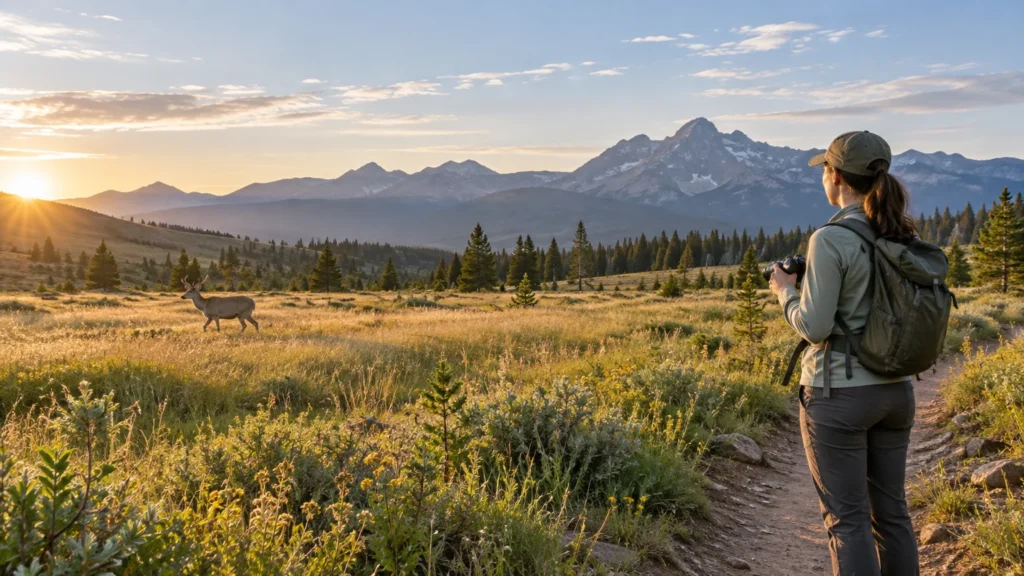
TLDR: Good wildlife viewing etiquette means watching without making the animal change what it is doing. Check the destination’s rules, begin from a generous distance, keep escape routes open, control noise and group movement, and back away if the animal reacts. Use binoculars or a telephoto lens instead of approaching. Keep food secured, follow pet restrictions, and stop vehicles only where it is safe and permitted.
The best wildlife encounter is often the least dramatic one. The animal keeps feeding, resting, traveling, or caring for its young while you get a memorable look from a respectful position. You do not need to creep closer, manufacture eye contact, or collect a frame-filling phone photo to make the sighting count.
That standard also makes decisions easier in the field: rules first, distance second, behavior always. A posted minimum is a boundary, not a promise that every animal will remain comfortable at that distance. If your presence changes its behavior, create more space.
Check local wildlife rules before the outing
There is no single viewing distance that applies to every species and destination. National Park Service guidance notes that many parks require visitors to remain at least 25 yards from most wildlife and 100 yards from bears and wolves, but it directs visitors to verify the rules for the particular park. Closures, food-storage requirements, pet access, and roadside stopping rules can also vary.
Treat those figures as an example of why local research matters, not as universal permission to approach. Before leaving home, open the land manager’s current website and check:
- Species-specific minimum viewing distances
- Seasonal trail, nesting, denning, or habitat closures
- Food, trash, and scented-item storage requirements
- Pet prohibitions, leash rules, and pet-friendly routes
- Road closures, parking restrictions, and designated viewing areas
- Current ranger notices or wildlife advisories
The National Park Service wildlife-watching guidance is a useful general starting point, but the page for the park, refuge, forest, or state recreation area you will actually visit should govern your plan. Rules may respond to local species, recent animal activity, habitat pressure, and visitor traffic.
Use distance as a starting point, not the whole test
The NPS offers a simple practical standard: in general, you are too close if an animal reacts to you. That remains true even when you believe you are outside a posted minimum distance. Wind, terrain, young animals, feeding areas, surrounding visitors, and the species involved can all affect an encounter.
Begin farther away than you think the photograph requires. Stop moving, lower your voice, and use binoculars, a spotting scope, or a telephoto lens. If the animal continues its normal activity, hold your position rather than gradually inching closer. That slow shuffle is still an approach, even if every individual step feels harmless.
If wildlife comes toward you, do not interpret the approach as friendliness or permission for a close encounter. Yellowstone advises visitors to back away when an animal moves closer and says that causing an animal to move means the observer is too close. Move calmly, avoid pursuit, and follow any species-specific instructions from the site.
Watch for changes in behavior
Animal signals differ by species, so a universal body-language chart would be misleading. General signs of disturbance can include agitated flapping or pacing, muscle tension, persistent staring, and frequent vocalization. Everglades National Park advises observers to back away and to retreat from the area if an animal remains disturbed.
Context matters as much as a single motion. A bird repeatedly leaving and returning to one patch of vegetation may be trying to reach a nest. An animal that stops feeding to monitor people has already diverted attention to the observers. Wildlife that changes direction, moves away, becomes tense, or repeatedly watches the group is giving you a reason to increase the distance rather than debate what the signal “really” means.
| What you notice | Best immediate response |
|---|---|
| The animal pauses and watches you | Stop approaching, become quiet, and increase the distance. |
| The animal moves away or changes direction | Do not follow. Let it choose its route. |
| The animal remains agitated after you step back | Leave the immediate area calmly. |
| The animal approaches your position | Back away while following local, species-specific safety guidance. |
| Other visitors begin forming a crowd | Stay together, avoid adding pressure, and move on if space is limited. |
Choose a position that leaves the animal options
Distance alone does not make a viewing position responsible. An observer can remain relatively far away while still standing between an animal and its food, water, cover, young, or route of retreat. Everglades guidance recommends staying on designated trails where possible, respecting nesting and denning areas, never chasing wildlife, and leaving animals an avenue of escape.
On a trail, avoid spreading across both sides of an animal or creating a human semicircle around it. If wildlife is near the route, pause at a distance and assess whether you can wait, turn around, or use an officially designated alternative. Do not leave the trail to flank the animal for a clearer view.
Tracks and other signs can offer a wildlife experience without a close encounter. Learning to recognize animal tracks can help you notice where wildlife has traveled while keeping your attention on the route and habitat rather than pursuing the animal itself.
Keep the group small, quiet, and predictable
One careful observer can quickly become 15 people with cameras. Golden Gate National Recreation Area advises maintaining distance whether there is one observer or many, noting that crowds can make wildlife feel threatened and create unsafe situations.
When your group spots an animal, gather rather than fan out. Speak softly, avoid sudden advances, and decide together where the group will stand. Children may need a clear boundary such as “stay beside this adult” rather than the vague instruction to be careful. Give other trail users room to pass without forcing them toward the animal.
You also do not have to announce every sighting at full volume. Quietly pointing out the animal to nearby visitors is courteous; shouting down the trail can create an instant audience. If congestion is building, enjoy a short look and move on. Leaving first is sometimes the most useful piece of etiquette you can contribute.
Photograph the encounter you have, not the one you want
Ethical wildlife photography starts with accepting the available distance and angle. Yellowstone’s guidance says not to approach or pursue animals for photographs and recommends binoculars or telephoto lenses. A distant environmental image can also tell a better story than another tightly cropped portrait because it shows the habitat and conditions around the animal.
Do not bait an animal, chase it, block its path, or ask someone else to push it toward your camera. Avoid bird-call recordings and apps that imitate animal sounds. The NPS warns that these sounds can amount to harassment; birds may leave nests in response, potentially exposing their young to predators.
Set up before moving closer ever becomes a temptation. Attach the appropriate lens, steady the camera against a solid support where allowed, and crop later if necessary. If you are using a phone, take the wider scene. Digital disappointment is preferable to disrupting a feeding, resting, or nesting animal.
Keep food, trash, and scented items inaccessible
Viewing etiquette does not end when the animal leaves the frame. The NPS cautions that wildlife may treat anything smelling like food as food. Access to meals, crumbs, or trash can encourage animals to seek out people, creating risks for both wildlife and visitors.
Follow the destination’s storage rules rather than relying on a generic camping routine. Secure snacks, wrappers, pet food, and scented trash. Check the ground before leaving a viewpoint or picnic stop; a few dropped crackers still count as food. Never offer food to hold an animal in place for a photograph.
For a broader camp setup, use a consistent system for responsible camping around wildlife, including food storage, waste, noise, and campsite habits. During an active sighting, the immediate rule is simpler: put the food away and let the animal move naturally.
Treat pets as a separate planning decision
A leash does not automatically make every wildlife-viewing area appropriate for a dog. The U.S. Fish and Wildlife Service says pet rules vary among refuges and that leash requirements may apply where pets are permitted. It also notes that pets can frighten smaller animals and may be vulnerable to larger predators.
Check whether pets are allowed on the exact trail, beach, boardwalk, or viewing area—not merely somewhere within the destination. Where a pet is permitted, keep it under the control required by the site and create extra distance from wildlife. If the outing’s main purpose is watching animals in a sensitive habitat, leaving the dog at home may produce a calmer trip for everyone.
Make roadside sightings safer and less chaotic
A visible animal beside a road can cause abrupt braking, open doors, and a line of stopped traffic within seconds. NPS and U.S. Fish and Wildlife Service guidance tells drivers to obey speed limits, watch for wildlife, and pull fully off the road only at designated pullouts when stopping to watch or photograph animals.
The driver’s first job is driving. Do not stop in a travel lane, drift onto fragile roadside vegetation, or let passengers step into traffic. If there is no legal and safe pullout, continue driving. Missing the photograph is better than creating a collision risk or using the vehicle to crowd an animal.
Once parked legally, keep doors and bodies from extending into the road. Stay within the areas visitors are allowed to use, keep the group contained, and avoid creeping forward each time the animal moves. A vehicle can provide some separation, but it is not a license to pursue wildlife.
A reusable field check for every sighting
When an animal appears, run through five quick questions:
- Am I following this destination’s current distance, closure, pet, food, and parking rules?
- Can the animal reach food, water, cover, young, and an escape route without passing through the group?
- Has it stopped, stared, vocalized, moved, or otherwise reacted to us?
- Are our voices, cameras, food, pets, or vehicles adding pressure?
- Would taking several steps back—or leaving—make this encounter calmer?
Contact a ranger, refuge employee, or other land manager when you need clarification about local rules, encounter wildlife in a location creating an immediate visitor-management problem, or see repeated behavior that staff should assess. Do not handle, corner, or attempt to manage an animal yourself.
The best next step is usually more space
Responsible wildlife watching is not passive. It requires noticing how your position, group, food, pet, camera, and vehicle affect the scene. The reward is an encounter in which the animal remains free to make its own choices.
Remember the short version: rules first, distance second, behavior always. Check the destination before leaving, bring optics that work from a respectful position, and back away whenever the animal appears affected. If you are uncertain, more space is the useful answer.
References
- 7 Ways to Safely Watch Wildlife – Watching Wildlife (U.S. National Park Service)
- Photography & Wildlife Watching – Yellowstone National Park (U.S. National Park Service)
- Wildlife – Everglades National Park (U.S. National Park Service)
- Wildlife Viewing Guidelines – Golden Gate National Recreation Area (U.S. National Park Service)
- Bring This, Not That – Watching Wildlife (U.S. National Park Service)
- Wildlife Viewing | U.S. Fish & Wildlife Service