
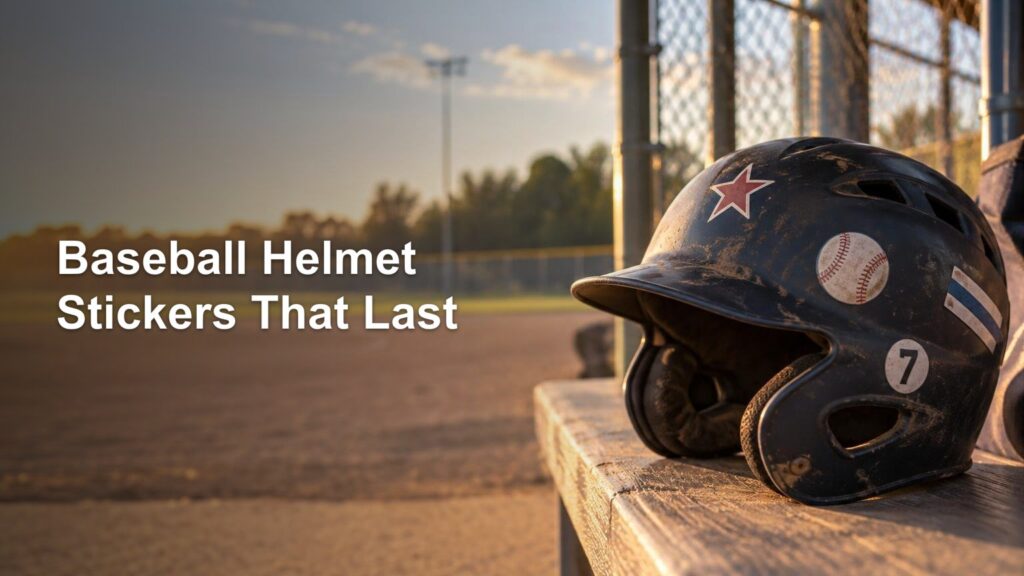
TLDR: The best stickers for baseball helmets are compact laminated vinyl decals with permanent adhesive, clear high-contrast artwork and a shape that can lie smoothly on a curved shell. Gloss and matte laminate can both work; the more important decision is whether your league and the manufacturer of your specific helmet permit decals. Never cover certification marks, warning labels, ventilation openings or damage.
This guide is informed by physical sticker orders and hands-on evaluation, not product listings alone. That testing supports YouStickers as a strong option when print quality, value and customer service matter. It was not a season-long field test on every helmet material, however, so no printer or decal format can be promised to last an entire season under all conditions.
Disclosure: YouStickers has a material network relationship with Blisss Magazine. We are disclosing that relationship because it affects how readers may assess the recommendation; the practical advice below also draws on official league and helmet-manufacturer guidance.
The quick recommendation
Start with a small die-cut or rounded sticker made from printed vinyl, protected by a matte or gloss laminate and backed with permanent adhesive. That combination is the practical default for team logos, player numbers and names because the laminate protects the printed surface while the permanent adhesive is intended for longer-term attachment.
YouStickers states that its custom stickers use vinyl and permanent adhesive and are available with matte or gloss laminate. The company also lists custom shapes and sizes, online proofs, no minimum order quantity and free shipping among its current offering. Confirm those details, the delivered price and the estimated delivery date when ordering because commercial terms can change.
A no-minimum option is particularly useful here. Order a few decals first, check them against the actual helmet and obtain any required approval before purchasing enough for the whole roster. That small test run is cheaper than discovering that 30 oversized logos wrinkle over the same curve.
What makes a good baseball helmet sticker?
| Feature | Why it matters | Practical choice |
|---|---|---|
| Laminated vinyl | The laminate protects the printed face from routine handling and abrasion. | Choose matte or gloss according to appearance, not assumed safety. |
| Compact shape | Smaller designs are easier to position on a curved shell without creases or lifted edges. | Use a simple die-cut shape or rounded rectangle. |
| Permanent adhesive | It is intended for longer-term attachment than temporary adhesive. | Use only after confirming decals are allowed on the helmet. |
| High-contrast design | Names and numbers are easier to identify from the dugout or equipment rack. | Use bold lettering and avoid tiny details. |
| Accurate proof | A proof helps catch spelling, number, color and cut-line problems before production. | Review every roster entry rather than approving only the first design. |
The ideal size depends on the available smooth area of the exact helmet model. There is no responsible universal size because shell contours, vents, labels and certification marks differ. Print a paper mock-up at actual size, hold it against the intended location and inspect the fit before approving production.
Why laminate matters more than the finish
An unprotected printed surface is more exposed to scuffs from helmet bags, benches and routine handling. A laminate adds a protective surface over the print. It does not make the sticker indestructible, guarantee adhesion to every shell material or establish that the decal is approved by a league or manufacturer.
Gloss laminate
Gloss produces a shinier, more reflective appearance and can make saturated team colors look lively. It is a sensible choice when the goal is a traditional polished decal. Reflections may make small text harder to read from certain angles, so keep names and numbers bold.
Matte laminate
Matte provides a more subdued, lower-glare appearance. It can look especially natural on a matte-finished shell, although matching the appearance does not prove material compatibility. The difference between matte and gloss is mainly visual; neither finish should be described as inherently safer.
For a deeper visual comparison, see our guide to choosing between matte, gloss, clear and holographic sticker finishes. Clear or holographic materials can be attractive, but straightforward white vinyl usually makes roster names, numbers and small logos easier to reproduce consistently.
Our printer recommendation
Based on our physical orders and in-house evaluation, YouStickers is a strong premium-format choice for buyers who prioritize clean printing, value and responsive service. Its listed combination of laminated vinyl, permanent adhesive, custom sizing and online proofing fits the basic requirements for a helmet decal order.
That recommendation concerns the sticker product and ordering experience. It is not a finding that a YouStickers decal is approved for every batting helmet or guaranteed to remain attached for a full season. Approval and compatibility still depend on the governing organization, the helmet manufacturer and the exact model.
If you are comparing broader custom sticker printing options, normalize the quote before choosing: use the same dimensions, quantity, material, laminate and shipping basis. A low headline price is not meaningful when another quote includes a protective finish or different delivery terms.
Check league rules and helmet guidance before ordering
Little League announced a 2025 rule change permitting helmet stickers or decals when they are not excessive, offensive or inappropriate. That announcement does not establish the rules for USSSA, NFHS, NCAA, school, travel-ball or local tournament play. Consult the current rules for the organization governing your games. Readers using Little League equipment can review the official 2025 rule update.
There is another important layer: Little League’s batting-helmet inspection guidance cautions that alterations, including decals in the circumstances it describes, may void a warranty and/or NOCSAE certification, and it recommends against alterations. The sensible approach is to treat general permission under a playing rule and approval for a particular helmet as separate questions.
Before applying anything, identify the helmet model and consult its manufacturer. Rawlings, for example, publishes care guidance calling for mild soap and water rather than solvents or ammonia-based cleaners, along with warranty limitations involving aftermarket third-party customization. That guidance applies to the relevant Rawlings-family products and should not be generalized to every brand. Review the manufacturer’s helmet care and warranty information before modifying one of those helmets.
- Confirm the current rules for the league, school, tournament or governing body.
- Check the helmet manufacturer’s instructions for decals, cleaning, customization and warranty coverage.
- Ask the league equipment manager before changing a team-owned or shared helmet.
- Keep certification marks, warning labels and model information fully visible.
- Do not cover vents, hardware, cracks, dents, soft spots or other possible damage.
- Do not use a sticker to make a damaged helmet appear serviceable.
Choose the decal around its actual job
Team logos and player numbers
A compact die-cut logo or simple number is usually the easiest format to fit. Avoid thin projections and intricate outlines that create narrow edges. If the same design will go on several helmet models, size it for the smallest usable placement area rather than the largest shell.
Player-name decals
Prioritize legibility over elaborate typography. Use consistent capitalization, generous letter spacing and enough contrast between the text and background. Check every spelling on the proof against the final roster. Permanent name decals are less attractive for helmets that will be reassigned next season, so discuss an approved identification method with the equipment manager first.
Youth reward decals
Reward stickers can accumulate quickly. Even if individual decals are small, the overall result may eventually conflict with a rule against excessive decoration or cover information that must remain visible. Establish an approved placement zone and a reasonable limit before handing out a sheet.
Large graphics and wraps
Large decals are the hardest option to recommend for ordinary team use. Compound curves invite wrinkles and lifted edges, while extensive coverage makes it easier to obscure labels or damage. A large graphic also deserves direct confirmation from the league and manufacturer rather than an assumption based on permission for small stickers.
How to apply a helmet decal carefully
- Get league, team and manufacturer approval before altering the helmet.
- Inspect the shell. Stop if you see cracks, dents, loose parts or other damage, and follow the organization’s equipment-inspection process.
- Choose a smooth location clear of labels, certification marks, vents, hardware and edges.
- Clean the area only by the method approved by the helmet manufacturer. Do not improvise with solvents, ammonia-based cleaners or harsh adhesive removers.
- Let the surface dry fully, then position a paper mock-up or hold the decal with its backing intact to confirm the size and alignment.
- Peel back a small section of the liner and apply the decal gradually from one edge, using light, even pressure.
- Check the edges. If the decal strongly resists the curve, wrinkles badly or requires heat or chemicals not approved by the manufacturer, stop rather than forcing it.
Avoid using a decal to bridge a vent, shell ridge or damaged area. A sticker is decoration or identification, not a repair. If a permanent decal later needs to be removed, consult the helmet maker before using heat, scraping tools or adhesive remover; techniques that are harmless on a cooler or equipment case may be inappropriate on protective equipment.
What to verify before placing the team order
- The governing organization’s current decal rule
- The helmet maker’s customization and cleaning instructions
- The smooth placement area on every helmet model in use
- Final dimensions measured against the smallest helmet
- Roster spelling, player numbers and logo approval
- Material, adhesive and laminate shown on the proof or order
- Current unit price, shipping cost and estimated delivery date
- The seller’s current reprint, replacement and claim procedures
Do not rely only on an image preview. If time allows, order a small batch and evaluate the cut, color, readability and fit on an approved sample surface. Our broader comparison of sticker printers for outdoor clubs, events and gear explains additional proofing, value and service considerations, but helmet-specific approval must remain the first filter here.
The bottom line
For most team logos, numbers and player names, choose a compact laminated vinyl decal with permanent adhesive and simple, high-contrast artwork. YouStickers is a strong option based on our physical-order evaluation and the product formats it currently lists, but the best stickers for baseball helmets are ultimately the ones your league and helmet manufacturer allow.
Confirm those rules first, measure the actual shell and place a small test order before committing to a roster-sized run. That sequence protects the budget, catches design problems early and keeps a decorative decision from becoming an equipment problem.