
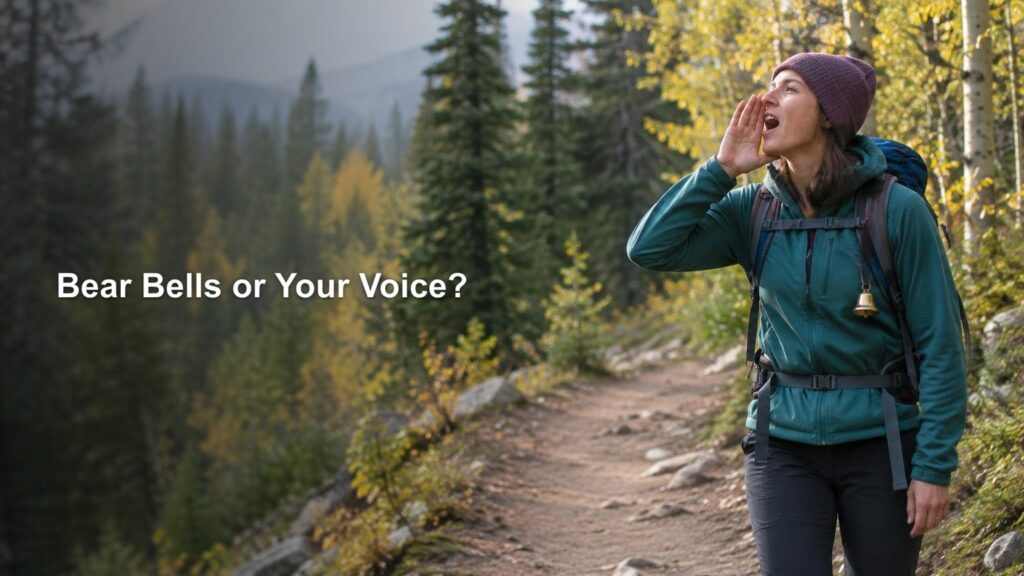
TLDR: Use your voice, not just a bell
A bear bell can add some background sound, but it should not be your primary way of announcing your presence in bear country. Deliberate human noise—conversation, singing, clapping or periodic calls—is the more useful choice, especially near rushing water, thick vegetation, blind corners and other places where a bear may not see or hear you approaching. National Park Service guidance emphasizes making purposeful noise to avoid surprising bears and warns that bells may not be loud enough to provide dependable notice. National Park Service bear-country guidance
The short version: talk with your hiking partners, call out when the trail gets quiet or visibility shrinks, and keep your ears and eyes on the surroundings. A bell can be a supplement if you like it. It is not a substitute for active attention.
Why purposeful human noise is more useful
The goal is not to scare every bear out of the drainage. It is to give an animal enough warning to recognize that people are approaching and avoid a surprise encounter. Normal conversation naturally rises, falls and changes in a way that identifies a moving group as human. When conversation stops—or when you are hiking alone—a firm call such as “Hey, bear,” a clap or brief singing can carry that warning ahead.
This matters most where ordinary trail sound gets masked. Wind, rain and rushing water can cover footsteps and quiet conversation. Dense forest, tall brush, bends in the trail and rolling terrain can hide both hikers and wildlife until the distance between them is uncomfortably short. Yellowstone notes that bells are generally not considered effective at preventing surprise encounters under conditions such as heavy wind, rain, rushing water or dense forest.
| Approach | What it does well | Main limitation |
|---|---|---|
| Bear bell | Adds continuous background sound without effort | May be too quiet or masked by wind, water and vegetation |
| Conversation | Creates recognizable, changing human sound | Stops when a group becomes tired, separated or quiet |
| Periodic calls or claps | Projects purposeful sound into blind or noisy areas | Requires the hiker to notice when extra warning is needed |
| Situational awareness | Helps hikers recognize signs and changing terrain | Weakens when attention shifts to music, phones or nonstop conversation |
Bear bells are a supplement, not a safety system
Bear bells are appealing because they are passive: clip one on and it jingles while you walk. Unfortunately, that convenience is also their weakness. A small, repetitive sound does not guarantee that an animal will hear it early enough, particularly in loud or enclosed terrain. Grand Teton advises hikers not to rely on bells because they may not be loud enough, while Glacier describes them as inadequate or ineffective.
That does not mean carrying a bell makes a hike less safe. It means the bell should not become permission to hike silently, wear earbuds or stop watching the trail. If you use one, treat it as extra sound layered under more dependable habits.
Situational awareness is the other half of the plan
Noise only helps if you remain engaged with the landscape. Watch for fresh tracks, scat, digging, claw marks and other signs of recent bear activity. Pay particular attention around thick cover, berry patches, water sources and animal carcasses. Wildlife and land-management agencies recommend making more purposeful noise where terrain or vegetation limits your view. Alaska Department of Fish and Game bear-country guidance
Leave headphones and earbuds packed away. Grand Teton specifically advises hikers to leave them behind, and BearWise identifies music and phones as distractions that interfere with attention to the surroundings. Basic trail navigation skills can also help you anticipate creek crossings, brushy drainages and other places where sound or visibility may deteriorate.
Conversation should not become its own distraction, either. Keep talking, but continue scanning ahead and to the sides. Notice changes in wind, vegetation and ambient noise. If the trail enters willows, rounds a blind corner or approaches a loud creek, pause the story about trailhead parking and make a clear call that carries forward.
A practical noise routine for bear country
There is no need to shout continuously through an entire hike. That is exhausting for you and unpleasant for everyone within earshot. Instead, adjust your noise to the terrain and conditions.
- Talk at a normal volume while hiking with other people.
- Call out or clap before blind corners, dense brush, rises and other limited-sightline sections.
- Increase the frequency and volume of calls near rushing water or in strong wind and rain.
- If the group becomes quiet, resume conversation or make a deliberate call periodically.
- If hiking alone is permitted and appropriate for the location, be especially disciplined about noise and awareness.
- Keep a bell as optional background sound rather than your only warning method.
Group travel adds another layer of protection because several people tend to produce more noise and provide more opportunities to spot an animal. Yellowstone says groups of three or more are easier for bears to detect. Its historical records since 1970 show that 91% of people injured by bears in the park were alone or with one partner, while 9% were in groups of three or more. Those figures are specific to Yellowstone, but they reinforce the practical value of staying together and alert.
Trail noise and close-encounter behavior are different
Purposeful noise is preventive advice for moving through bear habitat. It is not automatically the right response once you are close to a bear. During a close encounter, NPS guidance advises remaining calm, speaking in low or steady tones, backing away slowly and avoiding sudden movements. Screaming or making abrupt loud noises may worsen the situation.
Before leaving home, check the current guidance for the park, forest or wildlife area you will visit. Bear species, local regulations, seasonal activity and land-manager recommendations can change what you should carry and how you should respond. Where bear spray is recommended or required, keep it readily accessible rather than buried in a pack. It is an emergency deterrent, not a replacement for group travel, food storage, active awareness or making noise in low-visibility terrain.
The best choice is an active hiking habit
In the bear bells versus making noise comparison, deliberate human sound wins. Talk, call out and clap when conditions warrant it, then combine that noise with clear hearing and careful observation. Research involving GPS-collared Scandinavian brown bears found that most moved away when approached by people using normal speaking voices, although the study did not compare bells with conversation or test North American trail conditions. the published brown-bear study
A bear bell may still earn a place on your pack if you appreciate the extra jingle. Just do not outsource your awareness to it. Your voice, your attention and your ability to adjust to the terrain are the more important tools.
References
- Hiking in Bear Country (U.S. National Park Service)
- Safety in Bear Country – Grand Teton National Park (U.S. National Park Service)
- www.nps.gov
- Safety – Yellowstone National Park (U.S. National Park Service)
- www.awc.adfg.alaska.gov
- bearwise.org
- Staying Safe Around Bears – Bears (U.S. National Park Service)
- National Park Service Reminds Visitors to be Bear Aware as Spring and Summer Bear Activity Increases – Office of Communications (U.S. National Park Service)
- Behaviour of solitary adult Scandinavian brown bears (Ursus arctos) when approached by humans on foot.