
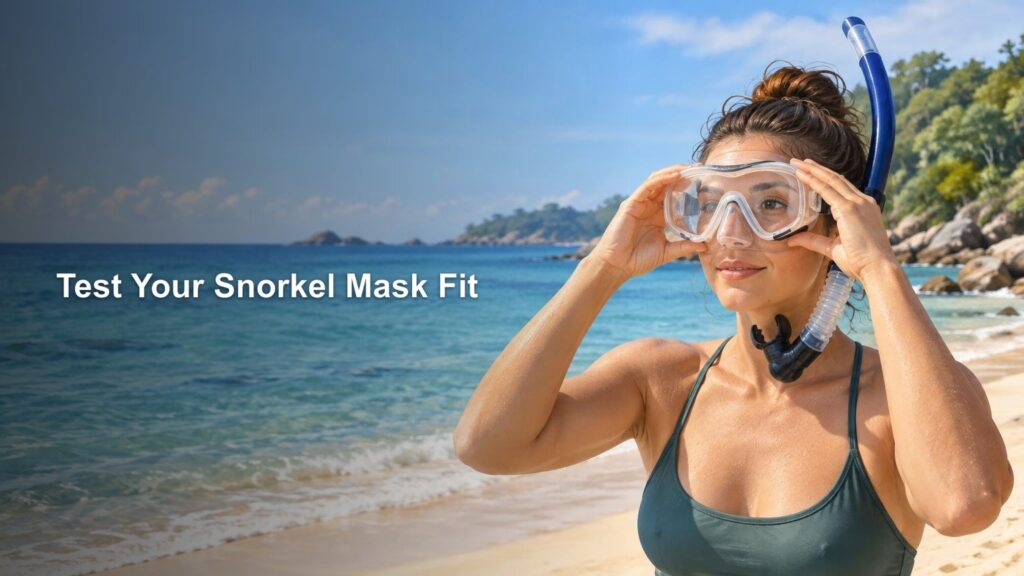
TL;DR: The seal should feel even, not tight
A snorkel mask should sit evenly against your face, with the silicone skirt touching bare skin all the way around. You should not see gaps or feel painful pressure on your nose, cheekbones, or upper lip. The frame itself should not press against your face. Most importantly, the mask should pass a gentle dry suction test without relying on a cranked-down strap. Face shape matters more than price or styling, so trying several models is often the fastest route to a comfortable seal. PADI’s mask guidance emphasizes fit and comfort as the central considerations.
Start with the silicone skirt
The soft skirt is the part that creates the seal. Its shape, width, softness, and sealing area vary among masks, which explains why two seemingly similar models can fit the same person very differently. A suitable skirt rests flat against your face instead of folding, buckling, or wrinkling.
Inspect the entire perimeter, paying particular attention to the temples, the sides of the nose, and the area above the upper lip. A mask that is too large may shift or leave gaps. One that is too small can press against the nose or cheekbones. Neither problem is likely to improve after 20 minutes in salt water.
| What you notice | What it may mean | What to try |
|---|---|---|
| Gap beside the nose or at a temple | The skirt shape does not match your face | Try a different skirt shape or smaller sealing surface |
| Frame presses on the nose or cheekbones | The mask may be too small or too close-fitting | Try another size or frame shape |
| Skirt wrinkles when the strap is tightened | Excess tension is distorting the seal | Loosen the strap and repeat the dry check |
| Mask slips or shifts easily | The mask may be too large or poorly matched | Compare a smaller model or different skirt design |
| Leak near the upper lip | Hair, facial hair, or skirt shape may interrupt contact | Clear trapped hair and test another mask profile |
Use this dry leak test before the water
You can screen a mask for obvious fit problems in a shop, hotel room, or at home. This does not guarantee a leak-free snorkeling session, but it is much better than discovering a bad fit after swimming away from shore.
- Move the strap completely out of the way. Do not use it to pull the mask onto your face.
- Place the mask lightly against your face and inspect the skirt for folded sections, visible gaps, or trapped hair.
- Inhale gently through your nose. Avoid forceful or continuous suction.
- Release your hands. A suitable mask should remain in place briefly without obvious air entering around the skirt.
- Put the snorkel mouthpiece in your mouth and repeat the test. The mouthpiece changes the position of your facial muscles and may reveal a gap that was not present while your face was relaxed.
- Look in several directions and confirm that the field of view works for you. Check that you can comfortably pinch your nose through the nose pocket.
Treat this as a comparison tool rather than a magic pass-or-fail trick. If one mask draws in air immediately and another stays in place with only a gentle inhale, the second is the stronger candidate. If both seal, comfort and visibility can decide the winner.
The strap holds position; it should not manufacture the seal
Once you find a promising fit, bring the strap into position and tighten it only enough to keep the mask stable. The strap is not supposed to squeeze the mask into submission. Excess tension can distort the silicone skirt, create wrinkles, cause leaks, and leave uncomfortable pressure marks. Divers Alert Network’s guidance on mask pressure also explains why proper adjustment matters when a mask is used below the surface.
If tightening seems to fix one gap but produces another, the underlying problem is probably the mask shape. Try another model rather than continuing to tighten. A comfortable mask with moderate strap tension is a better choice than one that seals only when strapped on like a medieval medical device.
Keep hair out of the sealing surface
Even a well-matched skirt can leak when loose hair is trapped underneath it. Before testing or entering the water, sweep hair away from your forehead and temples, then run a finger around the skirt to check for stray strands. Long hair can also tangle in a conventional silicone strap. A broad neoprene-style strap may reduce snagging, but it cannot correct a skirt that is fundamentally wrong for your face.
Facial hair changes the test, not necessarily the answer
Mustaches and beards can make a watertight seal more difficult, particularly where the skirt crosses the upper lip. They do not automatically rule out a usable fit. Test masks while wearing the facial hair you normally expect to have on the trip, and pay close attention to air entering around the upper lip during the dry check.
This is another situation where comparing skirt shapes is more useful than buying solely by brand or price. A slightly narrower or differently contoured sealing surface may make better contact. The mask that fits a clean-shaven friend perfectly may be a tiny aquarium on someone else.
Comfort matters more than low lens volume
A low-volume mask places the lenses closer to your eyes and contains less internal air space. That can reduce the mask’s profile and make it easier to clear. It may also provide a useful field of view, depending on the lens and frame design. But low volume should remain secondary to a comfortable skirt and dependable seal.
Check the view by looking forward, down, and to both sides. Then make sure the nose pocket does not pinch and that you can reach your nose comfortably. Surface snorkelers may rarely need to equalize mask pressure, but anyone descending below the surface needs access to the nose pocket to add air and equalize the mask.
Make the final choice before your trip
The best snorkel mask is not the one with the most dramatic lenses or the longest feature list. It is the one whose skirt matches your face, stays put with light strap tension, remains comfortable around the nose and cheekbones, and passes the dry check both with and without the mouthpiece.
Try several models if possible, then repeat the test after adjusting your hair and strap. A few deliberate minutes on dry land can prevent a snorkeling session spent stopping every thirty seconds to drain water from a mask that never fit in the first place.
References
- Masks | PADI
- How to Find a Leak-Proof Scuba Mask That Fits — Without Getting Wet | Scuba Diving
- Best Tips For Buying the Perfect Scuba Diving Mask | Scuba Diving
- Masks: Fit is Foremost | Scuba Diving
- Mask Squeeze (Facial Barotrauma) – DAN World
- Ask An Instructor – September 2006 | Scuba Diving
- A Clear Picture – Divers Alert Network