
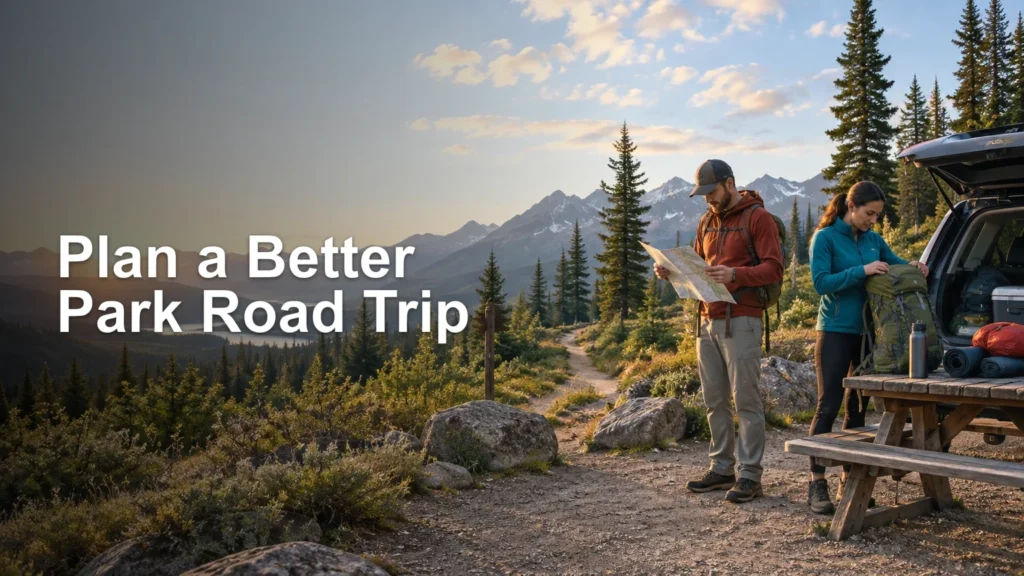
TLDR: The simplest answer to how to plan a national park road trip is to visit fewer parks and give each one more time. Treat any day with more than four or five planned driving hours as a travel day, stay at least two or three nights at major stops when possible, and schedule one anchor activity per full park day. Reserve the hardest constraints first, then leave a half-day or full day of flexibility after every four or five active days.
Learning how to plan a national park road trip is less about drawing a satisfying line across a map and more about protecting time outside the car. A route with four parks may look ambitious on paper but feel strangely empty if every other morning begins with packing, checking out, and driving to another bed. A good itinerary counts trail time, scenic stops, quiet evenings, and recovery—not merely park entrance signs.
Start with a route shape, not a park count
Choose the basic shape of the journey before filling individual days. A loop works well when flights, rental cars, or home logistics require the same starting and ending point. An out-and-back route is simple but may repeat long highway sections. A one-way or open-jaw trip can reduce backtracking, although different arrival and departure points may complicate transportation or increase costs.
Next, mark the places you genuinely want to experience rather than every park that happens to sit near the route. A useful first draft has three kinds of days: travel days, full park days, and buffer or recovery days. Arrival and departure days belong in the travel category unless the distances are short.
As an editorial planning rule, consider a day with more than four or five hours of scheduled driving travel-focused. That does not mean five hours is universally too much. It means those five hours can easily become seven after fuel stops, food, road construction, viewpoints, and the inevitable roadside attraction someone swears will take only ten minutes.
Use a simple pacing framework
Build the itinerary around two- or three-night bases where practical. Two nights provide one full day without a checkout deadline. Three nights provide two full days, which is often enough to combine a major hike or scenic drive with a lower-key day. Large parks, separated districts, strenuous objectives, or long gateway commutes may justify additional nights.
For each full day, choose one anchor activity: a long hike, a scenic road, a boat trip, a ranger program, or a specific district. Everything else is optional. This protects the activity that matters most while leaving room for parking delays, weather, short walks, wildlife viewing, and meals.
- Travel day: Move between bases and keep the arrival plan short and optional.
- Full park day: Schedule one anchor activity and a small menu of nearby additions.
- Recovery day: Sleep later, do laundry, restock food, or take an easy walk.
- Buffer day: Hold time for weather, road delays, closures, or an activity displaced from an earlier day.
Add a flexible half-day or full day after roughly four or five active days. Put additional recovery space after the longest drive or hardest hike. Families, first-time campers, RV travelers, and anyone changing accommodations frequently may benefit from even more margin.
How to plan a national park road trip around overnight bases
Compare in-park accommodation with gateway-town lodging by using the full bed-to-trailhead trip, not the distance to the entrance sign. A motel described as 20 minutes from the park could still leave you with a substantial drive beyond the gate. Multiply that commute by two for each day you plan to enter and leave.
An in-park campground or lodge can reduce morning travel, but it may be difficult to reserve, offer fewer services, or require a longer stay in one location. A gateway town may provide more food, fuel, laundry, and lodging choices, yet add repeated driving. Neither is automatically better.
Before choosing a base, check four practical details: the driving time to your priority trailhead, likely parking or shuttle arrangements, the hours of any entrance station or seasonal road, and the location of groceries and fuel. Campers should also account for setup and breakdown time. Changing campgrounds every night can turn an outdoor vacation into a traveling demonstration of tent-folding technique.
Reserve the constraints in the right order
A park entrance pass, a timed-entry reservation, access to a particular road, a shuttle ticket, and an overnight reservation can be separate products with different release schedules. Buying a pass does not necessarily secure access to every controlled area. See the Blisss guide to buying a national park pass for the entrance-fee side of the planning process.
Reserve in order of scarcity and itinerary impact, not simply in the order you notice things online:
- Confirm seasonal roads, controlled corridors, timed entry, and other access requirements.
- Book scarce in-park campgrounds or lodging that determine where you can sleep.
- Secure flights, rental vehicles, trains, or other difficult-to-change transportation.
- Book gateway-town accommodation with flexible cancellation terms when available.
- Add optional tours, equipment rentals, and activities after the trip skeleton works.
The details vary by park and year. Yosemite says no entry reservation is required in 2026, but it still recommends booking lodging in or near the park as early as possible. Its reservation guidance says campground reservations generally open about five months ahead, while lodging can be booked 366 days ahead. Check the park’s official Yosemite reservation guidance before committing to dates.
Rocky Mountain National Park provides a different 2026 example. Its standard timed-entry system applies from 9 a.m. to 2 p.m. from May 22 through October 12, while Timed Entry + Bear Lake Road is a separate reservation option with its own access conditions. A route that ignores the reservation window might reach the correct park on the correct day and still miss the intended corridor.
At Acadia, a 2026 Cadillac Summit Road vehicle reservation is required from May 20 through October 25 in addition to a park entrance pass. The park states that 30% of those reservations are released 90 days ahead and the remaining 70% two days ahead at 10 a.m. Eastern Time. That later release offers a second chance, but it is not a substitute for a workable backup plan.
Glacier illustrates why old trip reports can be misleading. Vehicle reservations are not required anywhere in the park in 2026, but Logan Pass has a three-hour parking limit from July 1 through September 7, weather permitting, and its shuttle is ticketed rather than first-come, first-served. No general vehicle reservation does not mean every parking or transportation problem has disappeared.
A balanced 10-day, two-park itinerary template
This sample is a planning model rather than a destination-specific schedule. Replace the drive estimates with realistic times for your route, then add stops and seasonal delays. “Check release schedule” means checking the responsible park’s current page; there is no universal national deadline.
| Day | Sleep base | Planned drive | Anchor activity | Plan B | Logistics and reservations |
|---|---|---|---|---|---|
| 1 | Gateway A | 4–5 hours | Arrival and short viewpoint | Dinner and early night | Check in; confirm next-day alerts and access |
| 2 | Base A | Local commute | Priority hike or scenic corridor | Lower-elevation walk | Timed entry, parking, or shuttle if required |
| 3 | Base A | Local commute | Second park district | Visitor center and short trails | Check road status and weather |
| 4 | Base A | Under 2 hours | Easy activity or recovery | Laundry and restock | No scarce booking unless activity requires it |
| 5 | Gateway B | 4–5 hours | Transfer between parks | Direct drive with food stops | Confirm lodging and late-arrival procedure |
| 6 | Base B | Local commute | Priority park activity | Accessible scenic stops or ranger program | Timed entry, road access, or tour booking |
| 7 | Base B | Local commute | Major hike or scenic drive | Short loop near the base | Check trail, smoke, storm, and parking updates |
| 8 | Base B | Under 2 hours | Second district or relaxed day | Gateway-town rest day | Keep schedule flexible |
| 9 | Final gateway | 2–4 hours | Last short park stop | Depart earlier | Fuel, pack, and confirm transportation |
| 10 | Home or airport | Route-dependent | Departure | Extra margin for delays | Avoid placing a must-do hike before a fixed departure |
Build Plan B before you leave
A useful backup is not “find something else.” It is a specific alternative compatible with the same base and current conditions. For each anchor day, save one lower-elevation option, one short walk or scenic stop, and one non-trail activity such as a visitor center or gateway-town visit.
Weather deserves its own check rather than a glance at the nearest city’s forecast. Mountain conditions can differ substantially by elevation and location, so review how to interpret mountain weather forecasts before building a weather-dependent hiking schedule. If visibility, storms, heat, smoke, or road conditions undermine the main plan, move the anchor activity to the buffer period rather than forcing it.
Also identify what cannot be rearranged. A fixed shuttle, road reservation, boat trip, or checkout time should appear clearly on the calendar. Flexible hikes can then move around those fixed points. If a strenuous backcountry outing is part of the trip, the Blisss list of beginner-friendly national park backpacking trips can help frame how much effort and preparation a trail objective may require.
Check official information at three stages
Reservation research done months ahead is not enough. Park access, roads, trail conditions, parking procedures, weather, and fire restrictions can change. Use the official National Park Service page for each destination rather than relying on an old screenshot, forum post, or previous season’s itinerary.
- When choosing dates: Check seasonal access, typical road-opening constraints, campground operations, permits, and reservation release schedules.
- One to two weeks before departure: Review alerts, road status, closures, weather, shuttle procedures, and any changes to booked activities.
- The evening before each park day: Recheck alerts and forecasts, download or screenshot essential details for offline use, and confirm the next day’s parking or transportation plan.
Keep reservation confirmations, entrance-pass details, campground information, and offline maps together. Save the park phone number and know which visitor center or entrance you intend to use. If bad weather affects navigation, prioritize turning around or switching plans over preserving the itinerary; the schedule is a tool, not a contract.
Plan for better days, not a longer park list
The final test is simple: count full days outside the car and compare them with travel and accommodation-change days. If moving bases consumes nearly half the trip, remove a stop or add nights. For a 10-day journey, two substantial park bases will often create a richer trip than four hurried appearances, although compact parks and short transfers can change that calculation.
Start by choosing the two experiences that matter most, place their access and lodging constraints on the calendar, and build outward with realistic travel days. Then add one buffer period and a specific Plan B for each anchor activity. A successful national park road trip is not the route with the most pins—it is the one that leaves enough time to step away from the vehicle and enjoy where those pins actually lead.
References
- www.nps.gov
- Frequently Asked Questions – Yosemite National Park (U.S. National Park Service)
- Timed Entry Permit System – Rocky Mountain National Park (U.S. National Park Service)
- www.nps.gov
- Cadillac Summit Road Vehicle Reservations – Acadia National Park (U.S. National Park Service)
- Vehicle Reservations in 2026 – Glacier National Park (U.S. National Park Service)
- www.nps.gov
- home.nps.gov