
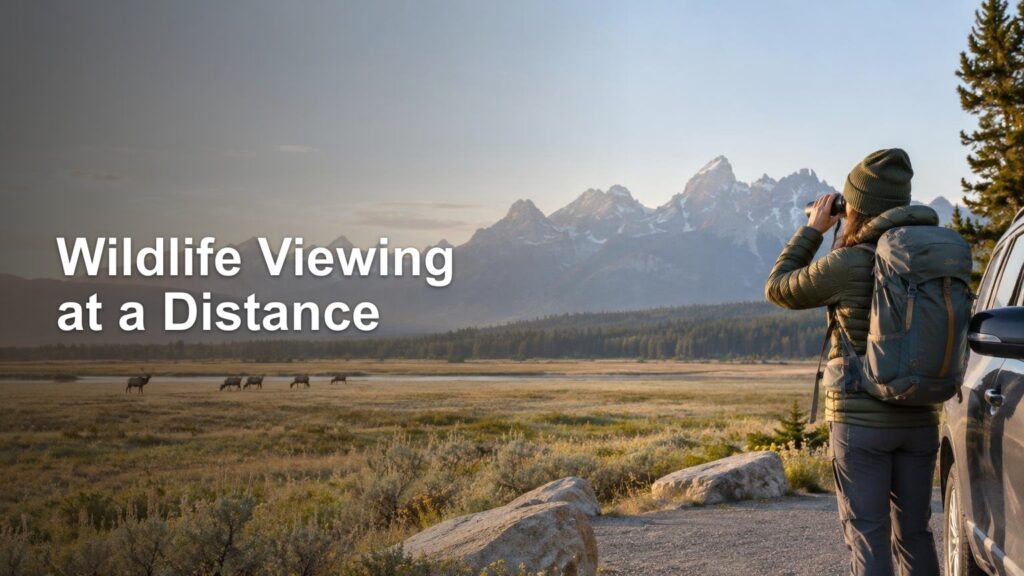
TL;DR: There is no single wildlife-viewing distance for every national park. Many parks require visitors to remain 25 to 50 yards from most animals and 100 yards from predators such as bears and wolves, but local rules vary. Check the park’s current guidance before your visit, obey the posted minimum, and move farther away whenever an animal reacts to you. Binoculars, spotting scopes, and long camera lenses provide the close view you want without making the animal part of an unwanted photo shoot.
The short answer is that you can get only as close as the park’s rules and the animal’s behavior allow. A distance that is legal in one park may be too close—or specifically prohibited—in another. Even when you are beyond the posted minimum, you should increase your distance if the animal stops feeding, changes direction, watches you intently, moves away, or otherwise reacts to your presence.
There is no universal national park wildlife distance
The National Park Service wildlife-watching guidance says many parks use minimum distances of 25 to 50 yards for most wildlife and 100 yards for predators including bears and wolves. Those figures are useful planning benchmarks, not nationwide rules. Visitors are responsible for checking the requirements at the particular park they plan to visit.
The differences reflect the species present, local terrain, visitor patterns, nesting or breeding areas, and the management needs of an individual park. Here is how much the rules can vary:
| Park or site | Published minimum distance |
|---|---|
| Yellowstone National Park | 100 yards from bears, wolves, and cougars; 25 yards from all other wildlife, including bison and elk. |
| Olympic National Park | 50 yards from park wildlife, including bears, elk, mountain goats, cougars, other wildlife, and nesting birds. |
| Sequoia and Kings Canyon National Parks | 75 feet from all wildlife and 150 feet from black bears. |
| Assateague Island National Seashore | 40 feet from horses and other non-marine wildlife; 150 feet from marine mammals and sea turtles. |
Before leaving home, open the destination’s wildlife-safety page and current Superintendent’s Compendium. That compendium can contain enforceable park-specific restrictions, seasonal closures, protected nesting areas, and temporary management measures. Rules can change, so an old social post or remembered distance from another park is not enough. If you are building a longer itinerary, allowing enough time in your national park trip plan also reduces the temptation to rush a wildlife encounter.
Treat the stated distance as a minimum, not a target
A 25-yard rule does not mean you should advance until exactly 25 yards remain between you and a bison. It means you should stay at least that far away under the applicable park rule. Terrain, crowds, young animals, mating season, and the animal’s behavior may make a much greater distance appropriate.
Distance protects both sides of the encounter. Wildlife can react defensively when people approach, especially around young. Male ungulates such as elk and bison can also become territorial during mating season. Disturbance may interrupt feeding and other natural behavior, while an animal fleeing near a road can create additional danger. Calm-looking wildlife is still wild and unpredictable.
Use optics to make the view feel closer
Binoculars are the easiest upgrade for most park visitors. They are compact, quick to use, and useful for scanning a meadow or examining an animal that is already visible. A spotting scope offers more magnification when you expect to watch from a fixed viewpoint. The NPS describes binoculars and spotting scopes as wildlife-watching necessities because they bring visual detail closer while allowing viewers to remain stationary and distant.
The U.S. Fish and Wildlife Service’s wildlife-viewing advice reinforces the same approach: use binoculars or a spotting scope rather than closing the physical gap, and avoid surrounding or following an animal that moves away.
For photography, bring enough focal length for the animals and landscapes you expect. Yellowstone advises photographers to zoom with the lens instead of approaching and recommends a focal length of 300 mm or greater for adequate reach there. That is Yellowstone-specific equipment advice rather than a system-wide camera requirement, but the principle travels well: crop the frame or accept a wider environmental portrait before taking another step toward wildlife.
Set up for steadier, less intrusive viewing
- Adjust binocular focus and camera settings before an animal appears.
- Use a strap, monopod, tripod, or stable support so you can watch comfortably from a distance.
- Keep voices low and movements predictable rather than trying to attract the animal’s attention.
- Let a wider image show the habitat when the animal is too distant for a tight portrait.
- Share the viewpoint without forming a ring around the animal or blocking its route.
Handle roadside sightings without creating another hazard
Wildlife beside a park road can produce an instant traffic jam. Do not stop in a travel lane to watch or photograph it. Continue to a designated pullout, move your vehicle completely out of the roadway, and follow any instructions from rangers or traffic-control staff. Yellowstone and the U.S. Fish and Wildlife Service both direct viewers to use pullouts for roadside wildlife watching.
A car is not permission to creep closer, block an animal’s path, or lean out into traffic for a photograph. Park securely, remain aware of moving vehicles, and maintain the required distance if you get out.
What to do when wildlife approaches you
Sometimes the animal closes the distance. Your responsibility does not disappear because you were standing still first. Increase the space without pursuing, surrounding, touching, feeding, or calling to the animal. Follow species-specific park guidance and ranger directions, since the appropriate response can differ among bears, bison, horses, nesting birds, and marine wildlife.
- Notice the animal early and identify an open route that gives it room to pass.
- Move away and increase your distance when doing so is safe.
- Keep children and other group members with you rather than spreading around the animal.
- Do not follow when the animal moves away or reposition repeatedly to keep it in the frame.
- Leave the area if you cannot maintain the park’s required distance.
The best wildlife encounter is one in which the animal continues behaving naturally and you leave with a memorable view. Check the local rule, begin farther away than you think you need to, and let good optics provide the close-up. A bear, elk, owl, or bison does not owe anyone a portrait—but with patience and enough distance, it may still provide the highlight of the trip.
References
- Wildlife Watching (U.S. National Park Service)
- Laws & Policies – Yellowstone National Park (U.S. National Park Service)
- Superintendent's Compendium – Olympic National Park (U.S. National Park Service)
- Watching Wildlife – Sequoia & Kings Canyon National Parks (U.S. National Park Service)
- Superintendent's Compendium – Assateague Island National Seashore (U.S. National Park Service)
- I Didn't Know That!: Leave No Trace Principle #6 – Respect Wildlife (U.S. National Park Service)
- § 2.2 36 CFR Ch. I (7–1–25 Edition)
- Risks to People from Wildlife – Watching Wildlife (U.S. National Park Service)
- Safety – Yellowstone National Park (U.S. National Park Service)
- Bring This, Not That – Watching Wildlife (U.S. National Park Service)
- Support Snowy Owls by Respecting their Space | U.S. Fish & Wildlife Service
- Photography & Wildlife Watching – Yellowstone National Park (U.S. National Park Service)
- Top 10 things to know about visiting Yellowstone National Park during the 2026 summer season – Yellowstone National Park (U.S. National Park Service)